
Has prayer ever felt like a blank page to you?
You bow your head, close your eyes, and… nothing. Or maybe there is something, but the feelings are too big or too hard to put into words. You know God is there. You know He hears. But somewhere between your heart and your lips; words just don’t come.
Or maybe, you start a prayer and before you know it, you’re planning dinner, prioritizing daily tasks, or thinking about what’s next in your day. Friend, you are in excellent company. Long before any of us ever struggled to pray, God, in His kindness, gave us a gift. An entire book of the Bible written as prayer.
The Psalms
This beautiful collection of one hundred and fifty prayers expresses every human emotion you have ever felt. They’re all there- joy, grief, fear,anger, confusion, wonder, gratitude, and everything in between.
The psalmists didn’t clean up their feelings before bringing them to God. They simply came before Him and laid it all out at His feet, and that means you can too.
Whether your prayer life feels stale, overwhelmed, or just completely silent right now, the Psalms are waiting to give your heart a voice. In this post, we’re going to look at four emotional “seasons” of life- praise, pain, peace, and trust- and discover which Psalms meet us in each one.
And at the end, I’ll show you a simple method for how to actually pray a Psalm, not just read it. Because there is a difference, and it can change your prayer life for the better.
Why the Psalms Are God’s Gift to Our Prayer Life
The authors (David, Solomon, and others; some anonymous) wrote the Psalms as songs and prayers. That alone should change how we approach them. While poetic, they aren’t just poetry to admire from a distance.
What makes them such a gift? They cover every human emotion, which means we can be as honest as the Psalmists- raw, weeping, confused, or overflowing with gratitude and know we are not alone in what we feel.
Praying the Psalms also keeps our perspective anchored where it belongs: on God rather than on ourselves. These are not superficial communications but honestly pouring out our true feelings.
We are “getting real” with God, and this deepens our personal relationship. He wants us to feel His love, know the depth of His care, and be the one we run to in all situations.
Perhaps most beautifully, the Psalms lead us to Jesus. We may come looking for comfort and find ourselves face to face with the promised Messiah, the Good Shepherd, the suffering Servant, and the risen King.
Think on this- even Jesus Himself prayed the Psalms, both in joy and in His darkest hour on the cross. When we pray them too, we are praying in the very footsteps of our Savior!
When You’re Full of Joy: Pray a Psalm of Praise
These Psalms give our joy a voice- when our hearts are full, when we’ve witnessed His goodness, received an answered prayer, or simply woken up grateful, praise is the most natural response.
Psalm 100 is an open invitation to enter God’s presence with joy, celebrating that His faithfulness stretches from generation to generation.
Psalm 145 is David’s wide open declaration of praise, looking ahead to a day when all people everywhere will recognize and worship God for who He truly is.
Psalm 150 closes the entire book of Psalms on a high note: Let everything that has breath praise the Lord! When you don’t know how else to pray, sometimes this is enough.
When You’re Hurting: Pray a Psalm of Lament
If praise Psalms are for our grateful moments, lament Psalms are for the valleys. They remind us that suffering is not a sign of weak faith; it’s a part of this life, and God welcomes our honesty about it. Psalms for pain give us permission to bring our whole broken heart to the One who can heal it.
Psalm 22 opens with the anguished cry, “My God, my God, why have you forsaken me?”- the very words Jesus spoke from the cross. David walked through deep trial, but this Psalm doesn’t end in despair. It ends in trust. So can yours.
Psalm 86 is a prayer of devoted faith in times of deep trouble. David lays every need before God, describes the enemy closing in, and still closes with praise for who God is. It’s a beautiful model for honest, God-centered prayer.
When Your Life is in Chaos: Pray a Psalm of Peace
Psalm 23 The 23rd Psalm may well be the most well-known and beloved Psalm in the entire Bible. It is filled with poetic language that fills us with love for our Shepherd, our Savior, and thankfulness for all the blessings He showers down on us. These six verses have been a lifeline for God’s people for thousands of years, and they are for you today.
Psalm 3 is David confidently trusting God for protection and peace in a time of crisis. Do you have trouble sleeping during trials? Verse 5 will bring you peaceful sleep. (I memorized this verse for those times I was awake at 3am…)
Psalm 4 rejoices in God’s protection and peace. We can place our confidence in God because He listens (verse 3) when we call on Him.
When You’re Learning to Trust: Pray a Psalm of Faith
Trust is rarely a feeling; it’s a choice we make when circumstances tempt us toward fear. Psalms of faith build our confidence in God, not by telling us everything will be easy, but by reminding us of who He is. God offers us help for today and hope for the future, and these Psalms are where we go to receive both.
Psalm 27 opens with a declaration: “The Lord is my light and my salvation, whom shall I fear?” David didn’t write these words from a comfortable place; he wrote them in the middle of enemies and uncertainty. That’s what makes them so powerful for us today.
Psalm 121 is a beloved reminder that our help comes from the Lord, the Maker of heaven and earth. He doesn’t sleep. He doesn’t look away. Jesus is watching over you right now.
How to Pray a Psalm (A Simple Method)
Praying the Psalms is different from reading them, and that difference is everything. When we read a Psalm, we take in the words. When we pray a Psalm, we let those words become a conversation with God.
We slow down, we listen, and respond. Think of it less like reading a passage and more like sitting with a letter God wrote specifically for where you are today.
Here’s a simple method to try:
- Read it slowly, out loud if you feel comfortable. There’s something about hearing the Psalms spoken that makes them land differently. Don’t rush. Read it the way you’d read a letter from someone you love.
- Pause where something catches your attention. Maybe a phrase catches in your chest. Maybe a line makes you want to cry, or exhale, or say Yes, that’s it. Stop there. Don’t move on. That feeling is worth your attention.
- Make it personal. This is the heart of praying Scripture. Take the words of the Psalm and bring your life into them. Use “me” and “my” instead of “your”- for example- “who forgives all my sins...” Insert your name or your situation. If Psalm 23 says, “He leads me beside still waters,” ask yourself, Where do I need to be led right now? What in my life feels anything but still? Then talk to God about that.
- Talk back. The Psalms were not intended to be a monologue. After you’ve read and paused and made it personal, respond. Thank God for what the Psalm revealed about Him. Ask Him for what you need. You don’t need perfect sentences; even a few words whispered from a real place are more powerful than a polished prayer that doesn’t cost you anything.
- Close with one line you want to carry with you. Pick one phrase from the Psalm to tuck into your day. Write it on a sticky note. Text it to a friend. Let it be the thing you return to when the day gets hard.
That’s it. No seminary degree required. No perfect quiet time. Just you, God, and the words He already gave you, waiting to become your prayer.
A Final Word
My love for the Psalms began with my dad. He had a small book containing only the Psalms, and because they meant so much to him, he gave me a copy. I asked him to sign it in his chicken-scratch handwriting- a reminder that these words comforted and guided him, and that he wanted the same peace and assurance for me.
Friend, the Psalms can be your lifelong companion in prayer. Don’t rush through them. Sit with them. Find the nuggets of care and love that live within each one. Let the honesty of the psalmists guide you into a deeper, more genuine relationship with God. Amen!
Blessings!
AnnMarie
Want to Take This Deeper With Your Daughter/Friends/Sister?
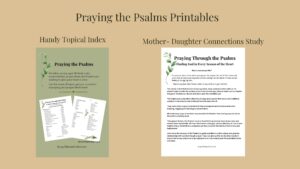
This month’s Mother-Daughter connection series walks you through the Psalms together; learning how to bring your real emotions to God, find peace in His Word, and build a prayer life that comes alive. Based on this post, each week includes Scripture, a reflection question to talk about together, an action, and a conversation starter.
Join the Mother Daughter Connection Series and start praying the Psalms together this month!
PLUS– grab the free Praying the Psalms printable guide: your go-to list of Psalms for every season of life. Click on the image below to access both in my free Bible printables page.
All Scripture is taken from the New International Version unless specified otherwise.
Photo Credit: Canva