
The miracles of Jesus are often seen as events that defy the laws of nature, showing us His divine power and authority. While many of these miracles bring healing, deliverance, and restoration, there’s one that stands out as a bit different. It’s not a healing or a restoration, but a curse. Today, we’re going to explore the meaning of the fig tree and how this miracle teaches us deep lessons about faith and fruitfulness.
What Does the Bible Say About Fig Trees?
Fig trees are mentioned early on in Scripture. In Genesis 3:7, when Adam and Eve realized they were naked after sinning, they sewed fig leaves together to cover themselves.This simple beginning sets the stage for a larger Biblical symbolism of fig trees.
Throughout the Bible, the fig tree is often used as a symbol of Israel.
- In Hosea 9:10, Israel is depicted as a fig tree that once had a close relationship with God. “It was like seeing the early fruit on the fig tree.”
- Micah 7:1 speaks of Israel’s spiritual fruitlessness, describing it as having “none of the early figs.“
- When Israel persists in sin, Jeremiah 29:17 likens them to “rotten figs.”
- But, God also promises restoration, saying in Joel 2:22 that “the fig tree and vine yield their riches.“
God’s design for Israel (and for us) was to walk faithfully with Him, producing spiritual fruit as a reflection of His presence in our lives. This theme of fruitfulness is central to our understanding of Jesus’ curse on the fig tree.
The Story of the Fig Tree
You can find this story in Matthew 21:18-22; taking place during the Passover season. Jesus enters Jerusalem triumphantly, riding on a donkey, fulfilling prophecy and setting the stage for His ultimate sacrifice.
He clears the temple of the buyers and sellers, spent the day teaching, healing people, and confronting the religious leaders who were plotting against Him.
After such a tense day, Jesus retreated to Bethany for some rest. Early the next morning, He and His disciples were heading back to the city when Jesus spotted a fig tree by the road.
Jesus Curses the Fig Tree
“Early in the morning, as He was on His way back to the city, He was hungry. Seeing a fig tree by the road, He went up to it but found nothing on it except leaves. Then He said to it, ‘May you never bear fruit again!’ Immediately the tree withered.” (Matthew 21:18-19)
At first glance, it seems like Jesus was just hungry and frustrated with a fruitless tree. But, as always with Jesus, there’s a deeper meaning.
This was no random outburst. The fig tree symbolized something much more profound.
The Fig Tree’s Symbolism
In the early spring, around the time of Passover, fig trees rarely have fully ripe fruit. They might have small buds, but not mature fruit.
However, if a fig tree was full of leaves, it gives the impression that it should also have fruit. This tree, with its lush leaves but no fruit, was a picture of “false advertising”- a misleading appearance of fruitfulness.
Jesus expected to find fruit, but He found nothing. This tree was symbolic of Israel’s spiritual state. They had the outward appearance of being God’s people, with their religious practices, sacrifices, and rituals, but they lacked true spiritual fruit.
This is why Jesus cursed the tree. It was a visual lesson for His disciples about God’s anger at religion without substance.
What Does This Teach Us?
Jesus used this moment to teach His disciples (and us) some important lessons.
1. The Importance of Bearing Spiritual Fruit
Jesus often taught that the fruit we bear reveals who we are. In Matthew 7:16-17, He said, “You will know them by their fruits. Do men gather grapes from thorn bushes or figs from thistles? Even so, every good tree bears good fruit, but a bad tree bears bad fruit.”
Just as the fig tree was expected to bear fruit, we are called to live lives that produce good fruit. The Holy Spirit produces character traits in every believer that are found in the nature of Christ.
If we want them to grow in us, we must love Him, know Him, and imitate Him. Are we showing love, kindness, patience, and other qualities that reflect the character of Christ?
God desires for us to bear fruit, not just outwardly, but from a transformed heart.
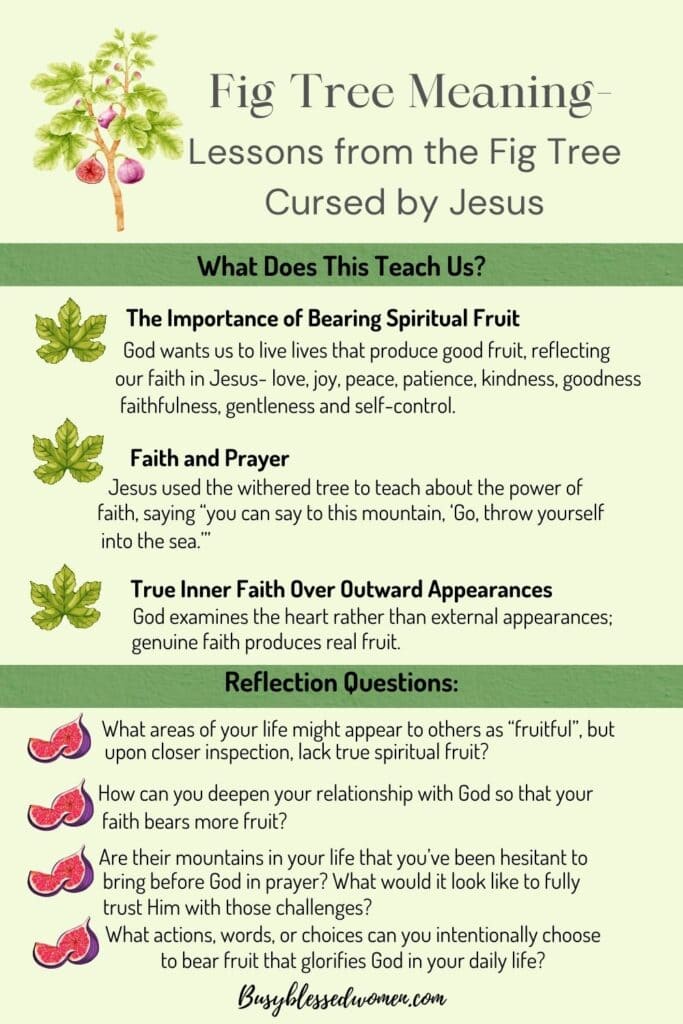
2. Faith and Prayer
The withered fig tree amazed the disciples. When they asked Him how it had withered so quickly, Jesus taught them about the power of faith in prayer:
“I tell you the truth, if you have faith and do not doubt… you can say to this mountain, ‘Go, throw yourself into the sea,’ and it will be done.” (Matthew 21:21)
The key here is faith. Jesus was teaching His disciples that genuine faith- faith that believes in God’s power- can move the mountains we face in life.
We should root our prayers in trust of God’s ability to do the impossible. But this faith also needs to be sincere and real, not based on empty rituals or appearances.
3. True Inner Faith Over Outward Appearances
The fig tree’s appearance was deceiving. It looked healthy with its leaves, but it lacked the fruit it was supposed to bear. Similarly, many people can appear religious on the outside, but if their faith isn’t genuine, there’s no real fruit.
The lesson here is that God looks beyond the surface and examines the heart. Are we just going through the motions of religion, or are we cultivating a true, vibrant relationship with God that results in fruit?
Reflection Questions
- What areas of your life might appear to others as “fruitful,” but upon closer inspection, lack true spiritual fruit?
- How can you deepen your relationship with God so that your faith bears more fruit?
- Are there mountains in your life that you’ve been hesitant to bring before God in prayer? What would it look like to trust Him fully with those challenges?
- How can you intentionally seek to bear fruit that glorifies God in your daily life- through actions, words, and choices?
Conclusion
The miracle of the fig tree is much more than just a strange event in Jesus’ ministry. It’s a call for us to examine our hearts and our spiritual lives. Are we bearing the fruit that God desires? Are we living with genuine faith, trusting in His power and grace?
May we always strive to live in a way that produces fruit that glorifies our Heavenly Father.
Blessings!
AnnMarie
All Scripture is taken from the New International Version unless specified otherwise.
Photo Credit: Canva