
Salt might seem like a simple kitchen ingredient, but in the Bible, it carries deep spiritual meaning. Jesus called His followers “the salt of the earth” (Matthew 5:13), pointing to salt’s value in preserving, purifying, and adding flavor. From Old Testament sacrifices to New Testament teachings, salt is rich with symbolism that reveals truths about our relationship with God and our role in the world. In this Bible study, we’ll explore what salt represents in Scripture and how its meaning applies to our everyday walk with Christ.
Uses of Salt
Salt acts as a flavor enhancer in recipes. Our food would taste bland without it. In bread, salt controls the fermentation of the yeast which gives the bread a better texture.
In pastry, salt encourages browning and also gives a better texture. Salt is a natural preservative, so our cookies and baked goods last longer (yay!) Some of these same qualities of salt come through in the spiritual meaning of salt as well.
Salt in the Bible
•Salt had many uses in Biblical times. God instructed the Israelite’s in the Old Testament to season all their grain offerings with salt.
•The “salt covenant” in Numbers 18:19 was in regard to God making strong, enduring promises to the Israelite’s. Offerings seasoned with salt were a reminder that He promised to always provide for them.
•Elisha purified a bad water supply in Jericho with salt. Newborn babies were rubbed with salt for its antiseptic properties.
• It was also mixed with cattle feed, bartered with, and used in small doses as fertilizer.
The Salt of the Earth
When Jesus was teaching his disciples on a hillside (the Sermon on the Mount), he said “You are the salt of the earth. But if the salt loses its saltiness, how can it be made salty again? It is no longer good for anything, except to be thrown out and trampled by men. ” Matthew 5:13
Let’s take each sentence separately and see what Jesus meant for us to learn about the spiritual meaning of salt.
•“You are the salt of the earth”. Notice he didn’t say “some of you might be” the salt of the earth. His disciples are the salt. As His disciples then, we are to be the salt of the earth.
Salt was highly valued in Bible times due to it’s many uses. Roman soldiers were sometimes paid with salt instead of money. This led to the phrase “worth his salt” to describe an exceptional worker.
Just as salt gives food a richer, more pleasant flavor, we too should enhance those around us. Colossians 4:6 tells us to “season” our conversations “with salt”.
When I compared versions of that verse, they describe it as a conversation that is “gracious and attractive” and “pleasant and interesting.”
Salt was also used as a way to preserve fish and meat- to keep it fresh and slow it’s decay. We are called to be set apart, a preserving influence that counteracts the corruption in the world.
Jesus and Salt
•The next statement Jesus makes is “but if the salt loses its saltiness, how can it be made salty again? It is no longer good for anything, except to be thrown out and trampled by men.”
Jesus compares a disciple that does not live out the values of His kingdom with “unsalty” salt- salt that is not fulfilling it’s purpose. If we lose our “flavor”, we are useless.
We are here to enhance the lives of others by living and speaking like Jesus. If we lose our “divine flavor-enhancer” so to speak, then it is as if we have lost our “saltiness.”
Biblical Salt
Have you ever been to a humid climate and noticed rice in the salt shakers? It’s an attempt to keep the salt flowing by absorbing the moisture that clumps the salt and makes it unusable.
What contamination in our lives (being of the world) keeps us from being salt in the world?
Jesus instructed us to live out the spiritual meaning of salt of the earth. He’s counting on us to enhance the lives of others with our words and actions.
We are to be a preservative in a world full of moral decay. Our spiritual salt should be pure and free-flowing.
He’s asking us to live a holy life for Him and to point others His way. In John 17, Jesus is praying to His Father for His disciples. It’s a beautiful prayer.
In verse 18 He says “As you sent me into the world, I have sent them into the world.” We are sent out to be a blessing and influence on the world.
Have you ever noticed that after eating a salty meal, you get thirsty? If we are especially “salty”- might we make others thirsty for Jesus? I hope so!
Reflection Questions:
Our words should reflect what God has taught us in our lives. Are they savory (honorable? pleasing?) Or are they hurtful? Angry? Critical?
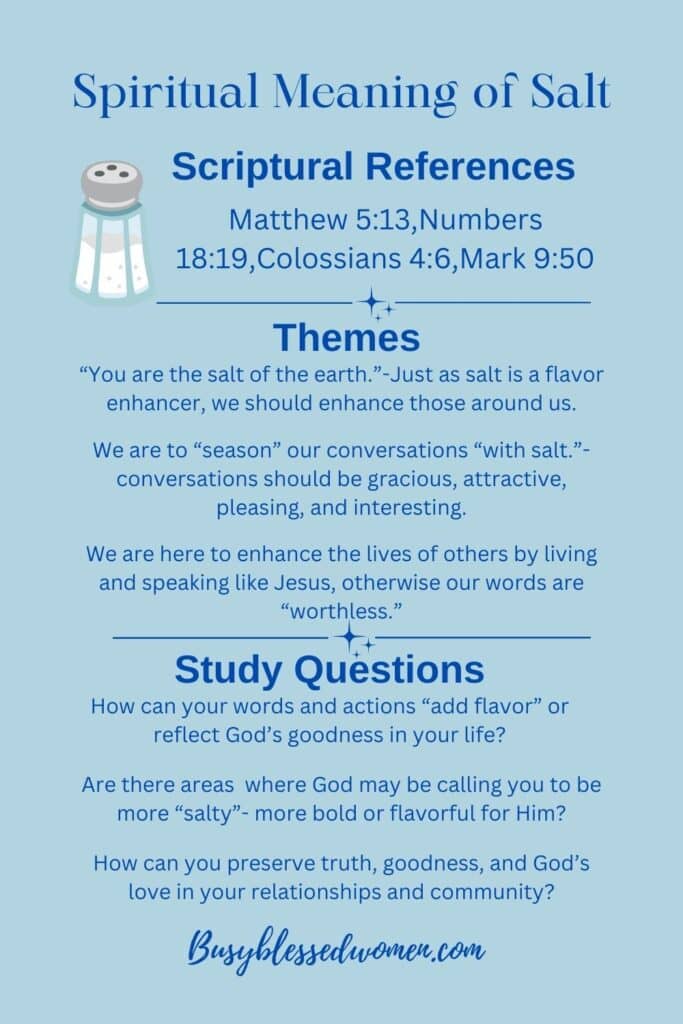
How can your words and actions “add flavor” or reflect God’s goodness in your daily life?
Have there been times when your “saltiness” (your spiritual influence) was strong? What about times when it felt weak?
Are there any areas in your life where God may be calling you to be more “salty”—more bold, preserving, or flavorful for Him?
How can you encourage or preserve truth, goodness, and love in your relationships and community?
Blessings!
AnnMarie
Mark 9:50- “You must have the qualities of salt among yourselves, and live in peace with each other.”
All Scripture is taken from the New International Version unless specified otherwise.
Photo Credit: Canva